
 최보식의언론
•
“Respected Worldwide”? Most People Don’t Know South Korea’s President
파워링크 AD 
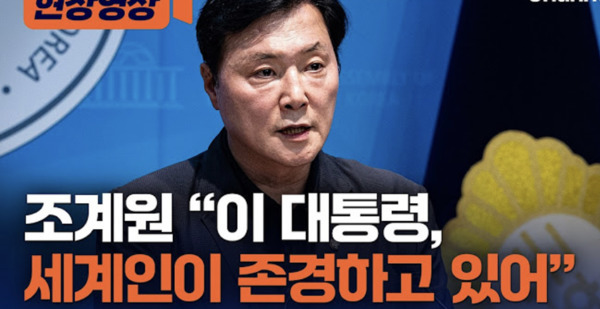
Recently, Cho Kye-won, a spokesperson for the Democratic Party of Korea (first-term lawmaker representing Yeosu-B), described President Lee Jae-myung as “a president respected by people around the world.” His remarks go beyond the bounds of extravagant praise for a ruler, provoking embarrassment and bitterness. Frankly, from the perspective of ordinary citizens hearing such words, the flattery is so excessive that it is downright humiliating.
In the National Assembly's press briefing room, which operates with taxpayers' money, a spokesperson serving as the official voice of the ruling party offered such crude flattery to the country's leader, so far removed from reality. The spectacle is utterly at odds with the common sense and expectations of the public.
Go out onto the streets of the United States, Europe, or any developing country and ask local citizens whether they know the name of South Korea's president. The overwhelming majority—perhaps 99.99%—may recognize the names Trump, Xi Jinping, Putin, and Kim Jong-un, but the cold reality is that they would not even know the three syllables of Lee Jae-myung's name. People often do not even know the names of European presidents and prime ministers, so how on earth would they know Lee Jae-myung's name? On what grounds could citizens of foreign countries who do not even know his name possibly express respect for him?
The Democratic Party spokesperson has effectively made an official confession that he is a “frog in a well,” so thoroughly indoctrinated by his own party's collective illusion that he has no idea how vast the world is. Without even a single concrete diplomatic achievement or verified international opinion poll to support it, the claim of “worldwide respect” amounts to nothing more than delusional self-congratulation that insults the intelligence of the public.
Looking back at South Korea's political history, excessive praise and flattery from ruling-party figures have never ceased whenever administrations have changed. During the Syngman Rhee administration, Interior Minister Lee Ik-heung reportedly displayed extreme servility when the president passed gas while fishing, saying, “Your Excellency, you must feel relieved.” The anecdote is often cited as an early example of power-worshipping obedience.
During the military dictatorships, presidents were virtually deified as “the sun of the nation” or “the savior of the country.” Under the Moon Jae-in administration, some ruling-party figures also stirred controversy with expressions such as “a blessing sent by God,” while devoted supporters called Moon “Moonlight” or described South Korea as “a country blessed to have Moon Jae-in.”
Even under the immediately preceding Yoon Suk Yeol administration, openly worshipful lyrics describing the president as “a leader sent from heaven” appeared at events involving the Presidential Security Service, drawing criticism as Yongbieocheonga for Yoon—a reference to a traditional hymn glorifying a ruler.
Yet most of these embarrassing expressions, repeated under successive administrations, remained largely confined to the language of devoted supporters, private acts of flattery, or unofficial remarks at particular events.
By contrast, the latest statement was made through an official press conference by the spokesperson of an established political party in democratic South Korea. It was the party's official position.
The appearance of such absurd language of personality worship in an official party announcement—language that would be difficult to hear even in the state-controlled media of authoritarian countries such as China or Russia, and that seems possible only in an isolated country like North Korea—lays bare the intellectual caliber and political regression of the current ruling party.
The reason such excessive loyalty and flattery repeatedly emerge among politicians from certain constituencies, including the Honam region, where securing a party nomination often virtually guarantees election, is also clear. Competition to demonstrate loyalty for the sake of securing nominations has gone too far, with politicians staking everything on winning the approval of those in power rather than representing the voices of local residents.
When the preferences of those controlling party nominations outweigh public sentiment, political language deteriorates to this level. Even praise must be offered in moderation, at the appropriate time and place, if it is to retain any dignity.
Excessive praise without context not only provokes resentment among those who hear it but also creates the paradox of flattery: it turns the very president being praised into an object of ridicule for the opposition and the public.
Before pointing fingers at criticism from the opposing party and accusing it of having “abandoned common sense and courtesy,” the Democratic Party should reflect on just how sensible its own language is when addressing the public.
A party spokesperson's briefing room is not a place to recite blind, sycophantic praise like a sunflower forever turning toward the person in power merely to please him.
What ruling-party politicians should concern themselves with is not winning the approval of those in power, but meeting the sober expectations of the people and listening to public sentiment.
jinannkim@gmail.com
#LeeJaeMyung #SouthKoreanPolitics #PoliticalFlattery
* This article has been translated by ChatGPT.
쿠팡 파트너스 활동의 일환으로,
이에 따른 일정액의 수수료를 제공받습니다.