176 읽음
투표용지 부족 사태, 재선거 요구하는 청년과 오세훈
 최보식의언론
 0
0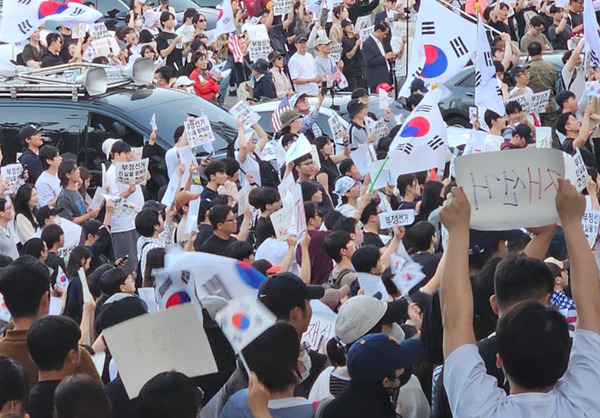
Following the sound, I found crowds gathered in front of the Handball Stadium holding signs that read "Re-Election" and waving South Korean flags.
Olympic Park is usually filled on weekends with K-pop concerts and enthusiastic young fans from around the world. In decades of walking there, I had never seen a political protest. Only then did I remember: the Handball Stadium was serving as the counting center where the ballot boxes from Jamsil 7-dong had been transported.
When I returned after making a lap around the park, the crowd had grown to roughly 2,000 people. It appeared that they were attempting to blockade the building in order to secure the disputed ballot boxes as "evidence" and election officials as "witnesses."
As a former newspaper reporter, I sat on a bench and observed. Roughly 90 percent of those present were people in their twenties and thirties. Many appeared to be couples attending together, almost as if they were on a date. There was no obvious leader directing the protest. It seemed somewhat unorganized, but perhaps that made it appear more genuine.
A JTBC reporter who had apparently been trapped inside the building tried to leave through a window and was briefly stopped by protesters. After some commotion, several participants intervened, saying, "We must not use violence" and "We cannot give them an excuse." They calmed the crowd and allowed the reporter to leave. I found their judgment admirable.
Male and female university students were helping organize the protest. I do not know whether they belonged to the conservative student group known as "Free University" that has been featured in the media. They repeatedly asked participants to stick only to the "re-election" signs and official slogans, wary of allowing outside agendas to infiltrate their movement.
The students distributed hamburgers, kimbap, Choco Pies, and bottled water. They even offered me a hamburger while I sat on the bench. The atmosphere was completely different from the elderly-dominated demonstrations often seen in central Seoul. It was orderly and remarkably clean.
A protest may look enormous from the inside, but from the perspective of a newsroom editor it often appears as nothing more than a tiny dot. The demonstration by thousands of young people demanding a new vote may be viewed the same way. Under conventional media standards, it might not even warrant more than a brief mention.
Yet sincerity often sees the essence of an issue more clearly than experts do.
I believe the young people's demand for a re-vote is justified and likely to grow in both scale and impact. Perhaps this is an exaggeration, but I was reminded of the university student demonstrations that erupted over election fraud before South Korea's April 19 Revolution.
Some argue that the ballot shortage was merely an administrative failure or negligence by election authorities and that there is no need to make a bigger issue out of it now that the election has already been decided.
I voted for Oh Se-hoon.
Many conservatives breathed a sigh of relief after his victory. Yet I consider this election fundamentally tainted.
Voters arrived at polling stations only to find there were no ballots available. Exit polls were released and vote counting had begun while voting was still taking place elsewhere. Even if there was no intention to manipulate votes, citizens' voting rights were infringed and proper election procedures were violated.
An election is compromised when the right to vote is compromised.
The number of affected voters may have been relatively small and may not have altered the final outcome. That does not change the principle involved.
Once public trust in electoral procedures is damaged, constitutional voting rights cannot be said to have been fully protected.
Who won matters.
But whether the election was conducted fairly matters even more.
That is the greater principle.
In Berlin's 2021 election, shortages of ballots, distribution of incorrect ballots, and voting that continued beyond legal closing times led the Berlin Constitutional Court to invalidate the election and order a new vote within ninety days.
On election night, People Power Party leader Jang Dong-hyuk called for vote counting to be suspended and demanded a new Seoul mayoral election, arguing that electoral fairness and voting rights had been seriously violated.
Oh Se-hoon himself stated that citizens' voting rights must never be infringed under any circumstances.
If Oh had narrowly lost, would he and his party have quietly accepted the result?
Most likely, they would now be loudly denouncing the election as fraudulent and demanding its annulment.
There is an old Korean saying that one's mindset changes between entering and leaving the restroom.
Now that victory has been secured, the silence is striking.
The ruling party criticizes the election commission but avoids addressing the deeper question.
Oh Se-hoon must state his position.
If President Lee Jae-myung or the Democratic Party had been the first to call for a new election, they would have been ridiculed and attacked. Even fellow conservative politicians hesitate to raise the issue for fear of creating political misunderstandings.
That is precisely why only the winner can do it.
Perhaps Oh Se-hoon shudders at the idea of risking a hard-fought victory.
Yet he should make that choice anyway.
Even if it means sacrificing immediate political interests, he should support a new election.
His victory was aided significantly by public dissatisfaction with the Lee administration. It was not purely a triumph of his own making. After serving as Seoul mayor multiple times, he is already a familiar political figure.
Now he has a chance to redefine himself.
He can demonstrate what democratic principles truly mean.
He can emerge not merely as a successful politician, but as a statesman remembered for defending electoral legitimacy.
If he were to call for a new election and President Lee reluctantly accepted, Oh might well win again. Conservative voters would likely rally in large numbers, viewing the election as a referendum on both the administration and the election commission.
Such a decision could ultimately open an entirely new chapter in his political future.