
227 읽음
A Warning from the 1,540 Won Exchange Rate: Why Is the Government Hiding the Truth?
 최보식의언론
 1
1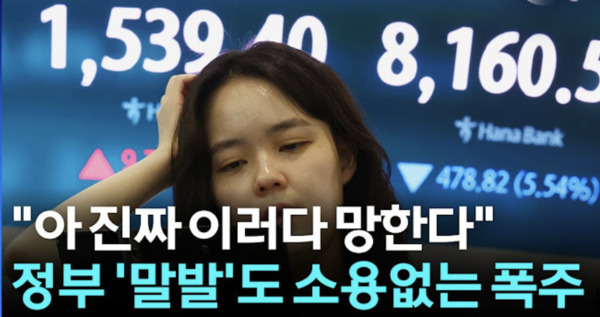
On the front lines of the real economy, where ordinary citizens struggle to make ends meet, voices are already warning that conditions have reached a breaking point. Yet economic officials remain remarkably complacent. Their defense is straightforward: South Korea now possesses more than $420 billion in foreign exchange reserves, semiconductor exports remain strong, and asset-market indicators appear healthy. Therefore, they argue, the current exchange-rate shock is simply the price the nation must pay before its next economic leap forward.
But this narrative is little more than a statistical illusion and a marketing exercise. It deliberately ignores the fact that while South Korea's economic structure has changed, so too has the domestic and international environment in which it operates.
The truly disturbing reality is that economic officials are not silent because they are unaware of the severity of the situation. They likely understand the alarming conditions on the ground better than anyone. Yet instead of confronting reality, they appear more concerned with protecting the administration and covering up policy failures. Rather than acknowledging the pain felt by ordinary citizens, they focus on promoting government achievements and inflating economic success stories, pushing the public toward dangerous misjudgments.
The government's monthly celebration of semiconductor export surpluses and rising stock indexes is largely an illusion. The semiconductor boom is concentrated in a handful of large corporations, generating limited trickle-down effects and relatively little employment growth. While major companies earn dollars abroad, ordinary households increasingly struggle at home.
The capital market, the heart of the economy, is already flashing warning signs.
Foreign investors have been net sellers of Korean equities for nineteen consecutive trading sessions, effectively staging an ongoing capital exodus. Despite massive daily sell-offs and declining stock prices, government officials continue to describe the trend as routine portfolio rebalancing or a temporary adjustment within a long-term bull market.
The government's attitude resembles that of a father proudly wearing a counterfeit luxury watch while his family struggles to pay the bills.
The real crisis lies not in the size of South Korea's foreign exchange reserves but in their quality.
The government boasts about reserve levels, but reserves are not equivalent to net wealth. Recently, authorities issued approximately $3 billion in Foreign Exchange Stabilization Fund bonds to support headline reserve figures amid exchange-rate volatility. It was the largest such issuance since 2009.
With interest rates ranging between 3.6 and 3.9 percent, these bonds will impose substantial future costs on taxpayers. It is akin to increasing the balance of an overdraft account and then claiming to be wealthy.
Even more troubling, roughly 90 percent of South Korea's reserves are tied up in U.S. Treasuries and other foreign securities. Truly liquid cash deposits reportedly account for only about 4 percent of total reserves, or roughly $21 billion.
When authorities intervene in currency markets by selling dollars to defend the won, it is this limited cash reserve that is consumed first. If intervention continues and liquid funds are depleted, the government could be forced to sell reserve assets at unfavorable prices.
Such a move would not only generate losses but also send a dangerous signal to global markets that South Korea's dollar liquidity is drying up, potentially accelerating capital flight.
This is why claims that "South Korea is fundamentally stronger than before" amount to little more than blind optimism copied directly from government talking points.
In today's fully liberalized capital markets, South Korea's ratio of short-term external debt to foreign exchange reserves has reportedly climbed to 43.3 percent, the highest level in fourteen years. In a crisis, foreign investors can withdraw short-term capital at a speed capable of draining reserves far more quickly than many officials seem willing to admit.
To claim that the economy is healthy simply because headline reserve figures remain large is like racing at 200 kilometers per hour in a worn-out vehicle while trusting a decades-old seatbelt to guarantee safety.
Economic officials must abandon their obsession with public-relations campaigns and confront reality.
A 1,540 won exchange rate means surging prices for imported oil, food ingredients, wheat, and countless industrial inputs. Households already face rising costs for groceries, heating, electricity, and transportation. This is not merely a fluctuation on a financial chart. It is a direct threat to living standards and a potential catalyst for deeper problems, including inflationary pressure and risks associated with South Korea's massive household debt burden.
Instead of wasting precious dollar liquidity in an effort to defend cosmetic numbers, the government should focus on building credible financial safety nets.
Among South Korea's currency-swap arrangements, only the unlimited standing swap agreement with Canada provides substantial reassurance. Bilateral swap lines with Japan, Switzerland, and Australia are either limited in scale or approaching expiration, reducing their effectiveness as crisis defenses.
Ultimately, the most important financial backstop remains a currency swap agreement with the United States.
At a time when global capital flows can shift abruptly, South Korea needs a comprehensive diplomatic and financial strategy that prioritizes national interests and economic security above ideological considerations.
The government should stop portraying economic pain as a necessary step toward future prosperity. It should stop relying on selective statistics and self-congratulatory narratives.
Instead, it must confront reality, accept responsibility for policy failures, and apply the emergency brakes before the situation deteriorates further.
Time is not on South Korea's side.
jinannkim@gmail.com
#KoreanEconomy #CurrencyCrisis #FinancialStability
* This article has been translated by ChatGPT.