
659 읽음
증권사 뒤늦은 하향 리포트, 폭락 후 낙관론 철회
 최보식의언론
 0
0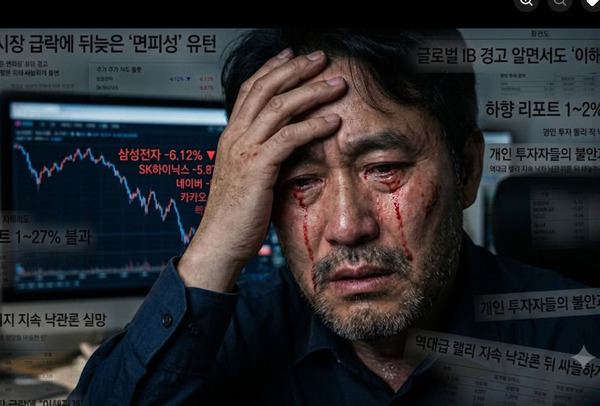
Only days ago, when Samsung Electronics announced record earnings, many Korean brokerage firms confidently predicted that the market's historic rally would continue.
Yet the moment the market began to unravel, that optimism vanished almost overnight.
After the KOSPI fell below the 7,000-point level and earlier forecasts proved inaccurate, brokerages suddenly released a flood of reports downgrading stocks and issuing more cautious recommendations.
To many investors, the abrupt reversal appears deeply irresponsible.
Looking back, warning signs had existed long before the sell-off.
Until recently, reports lowering target prices or expressing conservative views accounted for only 1–2 percent of all analyst reports in Korea.
While much of the domestic securities industry remained overwhelmingly optimistic, a small number of market observers focused on global developments repeatedly warned that Korean brokerages were overlooking growing risks.
Their warnings received little attention.
At the same time, major global investment banks had already begun cautioning clients about slowing semiconductor demand and emerging supply-chain risks.
It is difficult to believe that Korean analysts were unaware of those developments.
Critics argue that the issue was not a lack of analytical ability, but rather institutional incentives that discouraged publishing negative research.
Within Korea's brokerage industry, analysts who issue reports perceived as unfavorable toward major corporations may risk losing access to company management, corporate briefings, or other valuable information channels.
Brokerage firms also benefit from rising stock prices through increased trading commissions, investment banking activity, and financial product sales.
As a result, critics contend that analysts often function less as independent researchers than as participants within a broader commercial ecosystem.
Only after hidden risks materialized and the market declined sharply did sentiment change.
Faced with losses that could no longer be ignored, brokerages rapidly shifted their recommendations.
According to financial information provider FnGuide, downward revisions (323 reports) exceeded upward revisions (249 reports) this month—a dramatic reversal from previous trends.
Critics argue that this sudden change reflects an effort to limit reputational damage after earlier optimism proved misplaced.
The industry's tendency to portray the collapse simply as "the market's fault" has also drawn criticism.
Target prices themselves illustrate the degree of disagreement.
For Samsung Electronics, some firms projected values equivalent to 600,000 won, while others estimated 360,000 won.
For SK Hynix, target prices ranged from 4.2 million won to 1.85 million won—a difference of well over twofold.
Such wide disparities inevitably raise questions about the objectivity of valuation models.
Optimism That Ignored Risk
Critics argue that many bullish research reports effectively shielded investors from recognizing mounting risks.
While global investment banks highlighted potential challenges, domestic brokerages often maintained optimistic outlooks.
Whether motivated by commercial relationships or genuine analytical differences, the result was that many retail investors remained exposed to risks they believed had already been evaluated by professionals.
"Free Research" Is Not an Excuse
Whenever criticism arises regarding the quality of analyst reports, Korea's securities industry frequently responds that research reports are provided free of charge, unlike many reports produced by major U.S. investment banks.
Critics reject that argument.
Weather forecasts do not become exempt from scrutiny simply because they are publicly available.
Likewise, the price of information does not determine its responsibility or credibility.
Some investors now argue that they would rather pay for research that is demonstrably independent than rely on free reports potentially influenced by commercial interests.
In their view, the current system risks creating an information imbalance in which institutional investors receive higher-quality analysis while retail investors receive delayed or overly optimistic research.
Following the Crowd
Analysts who once hesitated to publish bearish opinions now appear increasingly willing to issue downgrade reports.
Critics argue that this shift reflects not only changing market conditions but also a desire to avoid standing alone when sentiment turns negative.
Some investors further contend that highly negative reports issued during sharp declines may intensify panic selling among retail investors while institutional investors accumulate shares at lower prices.
Whether this perception accurately reflects market behavior remains debated, but it has become increasingly common among individual investors.
Investors Should Look Beyond Analyst Opinions
Critics argue that ignoring known global risks before suddenly reversing course once markets collapse undermines confidence in the research industry.
Some therefore advocate introducing a stronger paid-research market that would reduce analysts' dependence on corporate access and brokerage sales incentives, encouraging research focused primarily on the needs of information consumers.
Ultimately, investors should avoid relying exclusively on changing analyst opinions.
During periods of heightened volatility, they argue, greater attention should instead be paid to measurable indicators such as actual AI infrastructure investment by major technology companies and sustained trends in foreign capital flows.
In the end, carefully analyzing objective data—not persuasive research reports—remains the investor's strongest protection.
jinannkim@gmail.com
#KOSPI #StockMarket #InvestmentResearch
* This article has been translated by ChatGPT.