
81 읽음
Oh Se-hoon–Yoo Meeting Revives Anti-Impeachment Unity Debate
 최보식의언론
 0
0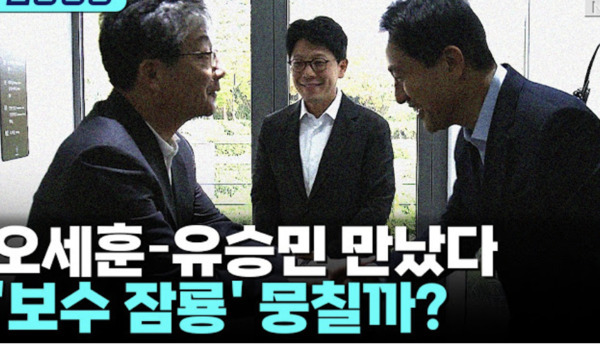
During the meeting, former lawmaker Yoo proposed a strategy of uniting even those forces that had opposed the impeachment of former President Yoon Suk Yeol. Mayor Oh reportedly shared the same view.
At first glance, the idea appears plausible. However, there is a fundamental flaw in Oh Se-hoon and Yoo Seong-min's assessment of political reality. The issue surrounding internal unity within the People Power Party is not whether to embrace those who opposed Yoon's impeachment. Rather, it is whether to embrace those who supported the impeachment. In other words, Oh and Yoo are not the driving force behind party unity but are themselves the ones to be integrated, as they belong to the party's minority faction. That is, unless their intention is to gather their own supporters and create a new political party.
The following article does not necessarily reflect the editorial position of this publication. It is presented to provide readers with a range of perspectives. (Editor's note).
Seoul Mayor Oh Se-hoon and former lawmaker Yoo Seong-min recently met over dinner. The meeting carries considerable political significance because it reflected a shared concern over the direction South Korea's conservative movement should take after losing momentum following the local elections. In particular, Mayor Oh is widely regarded within conservative circles as one of the few leaders who combines extensive administrative experience with broad appeal in the Seoul metropolitan area. His political moves therefore represent more than the ambitions of a single politician; they are increasingly seen as indicators of the future direction of conservative renewal.
The two leaders' agreement on the need for party reform and broader conservative unity suggests that the People Power Party must move beyond internal conflicts rooted in the past and begin discussing the future. Conservatism has been driven into a profound crisis after two presidential impeachments and consecutive defeats in nationwide elections. Yet the deeper problem is not simply electoral defeat, but the absence of any shared understanding of how those defeats should be interpreted. Within the party, political identity is still largely defined by divisions between pro-Yoon and anti-Yoon factions, and by differing positions on impeachment. The Korean public, however, is no longer asking who bears responsibility for the past. Instead, voters are asking whether conservatives are capable of rebuilding themselves into a credible political force that can once again be entrusted with the nation's future. Viewed from that perspective, the meeting between Oh and Yoo is significant not because it signals a personal alliance, but because it marks the beginning of a broader discussion about how conservatism should be rebuilt in the post-Yoon Suk Yeol era.
Moreover, despite the ongoing legal proceedings that have generated political controversy surrounding Mayor Oh, he continues to be regarded as one of conservatism's most competitive leadership assets. This suggests that the central challenge of conservative renewal is not to consume or discard capable leaders through internal political conflict, but to identify, develop, and protect leaders who possess genuine national electoral competitiveness.
A political party exists not to judge the past indefinitely but to prepare for the future. Former lawmaker Yoo Seong-min's observation that excluding those who opposed impeachment would effectively amount to breaking up the party, together with Mayor Oh Se-hoon's consistent argument that reform is necessary but should not permanently divide the conservative movement, reflects the same fundamental philosophy. While history and the public should ultimately evaluate the legacy of an individual president, politicians, party members, and supporters who worked alongside that president should not themselves become permanent political outcasts. Across the world's established democracies, political parties that suffered electoral defeat renewed their leadership and policies, but they did not overcome crises by permanently dividing their own members into enemies and allies. The essence of a democratic political party is to establish clear accountability while simultaneously creating an institutional order that enables political competition to resume and future cooperation to remain possible.
Korean conservatism has already experienced one version of a "big tent." After the impeachment of former President Park Geun-hye in 2017 and successive defeats in both the presidential and local elections, various conservative forces united under a single political framework ahead of the 2020 general election. The decision to unite itself was the correct one. The failure lay not in the integration, but in what followed. Bringing together different political forces under one roof is one challenge; governing them successfully as a single political party is quite another. Because fair rules of competition, effective mechanisms for managing internal conflicts, and a political culture in which all participants willingly accepted outcomes were never fully institutionalized, the momentum generated by unity gradually dissipated. This is precisely the lesson that conservatives must remember as they prepare for the 2028 general election.
Accordingly, what Korean conservatism now needs is not simply another electoral coalition, but a "mature big tent" that has learned from the failures of the past. Attempts to unite the party around a single presidential contender or to entrust sweeping authority to an outsider brought in as a political savior have both revealed their limitations. A political party is not a temporary campaign organization assembled for a single election. It is a political community built over time upon accumulated trust, organizational continuity, and regional support. Such a community can function effectively only when it is governed by fair rules and leadership capable of applying those rules consistently and impartially.
For that reason, the referee matters more than the players. If a presidential contender serves as the referee, it is difficult for other candidates to fully trust the fairness of the outcome. Likewise, an externally appointed emergency leadership may lack a sufficient understanding of the party's history, traditions, and organizational culture. The real objective, therefore, is not to elevate a particular individual as the next leader, but to establish nomination procedures and decision-making systems that every candidate can accept as fair and legitimate. To achieve this, the party may consider entrusting the temporary role of impartial integration manager to a respected senior statesman who understands the party's history and organization while remaining above factional interests. Former Labor Minister Kim Moon-soo could serve as one possible example of such a figure. The essential point, however, is not the individual himself. It is to establish a political system in which identical rules are applied fairly and without personal interest to everyone, enabling every political faction to accept the final outcome with confidence.
Upon such a foundation, the conservative movement's diverse political assets should once again be brought together around the same table. Mayor Oh Se-hoon's competitiveness in the Seoul metropolitan area and extensive administrative experience, Yoo Seong-min's vision for economic reform, Ahn Cheol-soo's expertise in science and technology, Na Kyung-won's long parliamentary experience, Han Dong-hoon's image as a reform-minded political leader, and Lee Jun-seok's appeal to younger generations and understanding of digital politics are all valuable assets that Korean conservatism should utilize. The central question is not who should stand at the front, but whether these leaders can compete through policies and vision under a shared commitment to liberal democracy, the market economy, the rule of law, and responsible government. Only when multiple leaders are able to compete openly before the public while cooperating within an institutional framework can a political party build lasting and sustainable competitiveness.
Political unity, however, must be grounded in clear principles. Respect for liberal democracy and the constitutional order is the minimum standard expected of any democratic political party. Broadening the party's appeal is certainly necessary, but unity achieved at the expense of constitutional principles or responsible politics cannot endure. Unity without principles is unsustainable, while principles without unity cannot earn the confidence of the electorate. Reform is the process of clearly establishing political accountability, whereas integration is the process of bringing together diverse strengths for the future. These are not competing values but the two complementary pillars upon which a healthy democratic party must stand.
The crisis facing Korean conservatism is not fundamentally a shortage of talented people. Rather, it is the collapse of a system capable of developing leaders and allowing them to compete fairly. A political party should never become an organization waiting for a single political hero. Instead, it should function as a democratic platform that identifies, nurtures, evaluates, and presents multiple leaders to the public through open competition. What conservatives must offer the Korean people in 2028 is not another slogan or simply another presidential hopeful. They must offer a political system worthy of public trust—one built upon fair competition, responsible leadership, and a compelling national vision for the future.
This is ultimately why the meeting between Mayor Oh Se-hoon and former lawmaker Yoo Seong-min carries genuine political significance. The central question is not who will control the party, but how conservatism can once again earn the confidence of the Korean people. What is needed today is neither reform without unity nor unity without reform. Korea needs a mature big tent in which every participant competes under impartial referees, equal rules, mutual acceptance of results, and shared political responsibility. When institutions, rather than personalities, become the foundation of political competition; when values, rather than factions, define political rivalry; and when political winners govern without excluding those who lose, Korean conservatism will finally be able to move beyond two presidential impeachments and successive nationwide electoral defeats, re-emerging as a responsible and credible governing alternative worthy of the public's trust.
jeongkeekim@naver.com
#SouthKoreanPolitics #ConservativeReform #PoliticalUnity