
1,051 읽음
Two Giants: Syngman Rhee’s Resolve and Kim Koo’s Tears
 최보식의언론
 1
1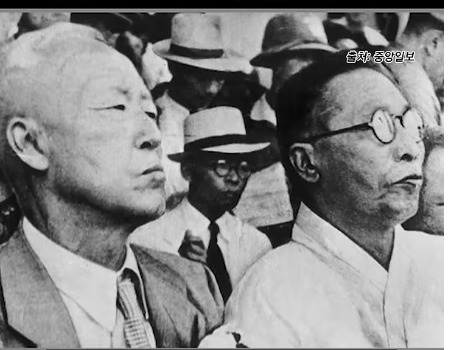
As we mark the 81st anniversary of liberation, I find myself thinking again about two towering figures of modern Korean history: Syngman Rhee and Kim Koo. Both devoted their lives to the independence of their homeland, yet after liberation they chose different paths. One chose to establish a liberal democratic state first amid the harsh realities of international politics; the other held fast to the ideal of a unified Korean nation until the end. For too long, we have tended to pit these two men against each other, as though understanding our history required us to choose one over the other. We no longer need to do so. Rhee’s decision is part of our history, and so are Kim Koo’s tears.
○ Syngman Rhee: From the Classroom to Hawaii
I first began to study Syngman Rhee in earnest in 1988, when I was a student at Yonsei University's Division of International Studies. At the time, I had the opportunity to take a Korean history course taught by Professor Young Ick Lew, a distinguished professor of Korean history who had earned his Ph.D. in history from Harvard University. Through his lectures, I began to see Rhee beyond the confines of textbooks and political judgments, placing him instead within the broader historical context of international politics and the founding of the Republic of Korea.
Rhee was among the earliest Korean leaders to grasp the harsh realities of international politics. After moving to the United States, he earned a BA from George Washington University and an MA from Harvard University before completing a Ph.D. in political science at Princeton University—all within just five years. His close exposure to American politics and diplomacy taught him that international affairs were driven not simply by ideals or moral principles, but by national power and national interests. He came to believe that appeals from a weak and stateless people alone would not be enough to secure independence, and that Korea would have to find a path to independence and survival within the competing interests of the great powers.
Decades later, in February 2025, I paid a courtesy visit to the Hawaii State Government and the Honolulu City Government in my capacity as Secretary General of the World Smart Sustainable Cities Organization (WeGO). During that trip, I met Lee Dong-kyun, Chairman of the Syngman Rhee Foundation. Looking out over the waters of Hawaii, we shared a bottle of wine and talked for nearly four hours about Rhee’s life. We traced his journey from independence activist to the first President of the Republic of Korea, and finally to his last years in Hawaii after leaving office.
Listening in particular to Chairman Lee’s vivid account of Rhee’s final years, I found myself thinking again about the man I had first come to understand through Professor Lew’s lectures in 1988. The Syngman Rhee I encountered in that classroom as a young man was different from the Rhee I encountered again in Hawaii decades later. The former was a political figure in history; the latter was a human being who had borne the burden of making choices that would determine the fate of a nation.
○ Kim Koo and the Korean Provisional Government in Shanghai
My memories of Kim Koo are inseparable from Shanghai. In April 2008, I received a call from the Presidential Office informing me that I had been appointed Consul General of the Republic of Korea in Shanghai. I could hardly contain my excitement. To me, Shanghai was more than simply a diplomatic post. It was the city where the Provisional Government of the Republic of Korea had been based and where Kim Koo and countless other independence activists had left their mark.
When I arrived at Shanghai Pudong International Airport and stepped into the official car flying the Korean national flag, I was deeply moved. I did not go directly to the Consulate General. Instead, I first visited the former headquarters of the Provisional Government of the Republic of Korea. There, in my heart, I reported my arrival to Kim Koo and the other independence patriots who had come before us. As the Consul General representing the Republic of Korea in Shanghai, I felt that paying my respects to them was the first thing I should do.
Kim Koo served as Head of the Police Bureau under Syngman Rhee, the first President of the Provisional Government of the Republic of Korea, and later emerged as one of its central leaders, eventually becoming its President. Despite relentless Japanese repression, repeated relocations, and chronic financial hardship, he helped keep the Provisional Government alive. His life itself embodied the history of an independence activist who lived through the tragic era of a nation deprived of its sovereignty.
Yet liberation could not have been an occasion of unqualified joy for Kim Koo. Japan was defeated in 1945, but the Provisional Government of the Republic of Korea was not formally recognized as a government by the Allied powers. Kim Koo and other members of the Provisional Government therefore had to return home not in an official governmental capacity, but as private individuals. Nor was the Korean Liberation Army ultimately able to fulfill its dream of liberating the homeland through an independent military campaign.
Even today, when I think of Kim Koo setting out on his journey home after liberation, my heart grows heavy. He was returning to his homeland, but it was not the triumphant homecoming of a victorious government-in-exile. He must have carried with him both the profound regret that the independence to which he had devoted his life had not been realized in the form he had envisioned, and the anguish of an independence fighter confronting the painful truth that his people had not liberated their homeland through their own strength.
○ Great-Power Politics and the Choices of Two Leaders
In the 1943 Cairo Declaration, the United States, Britain, and China declared their intention that Korea would become “free and independent” “in due course.” It was historically significant that Korea’s independence was explicitly affirmed in an official document issued by the Allied leaders. Yet there was a fundamental problem: Koreans themselves were not participants in shaping the international order that would determine their future.
At the Yalta Conference in 1945, the postwar order was discussed, and while the Cairo principle of Korean independence remained intact, the idea of placing Korea under an international trusteeship for a certain period before full independence was also considered. The Potsdam Declaration reaffirmed that the terms of the Cairo Declaration would be carried out, but no concrete political mechanism was established to ensure Korea’s immediate independence. Ultimately, as Soviet forces advanced rapidly through Manchuria and into northern Korea, the United States proposed the 38th parallel as the dividing line for accepting the surrender of Japanese forces. The Soviet Union agreed, and the Korean Peninsula was divided into American and Soviet occupation zones.
Here lies a harsh reality that we must remember: there were no Koreans at the negotiating table where the fate of the Korean Peninsula was being decided.
Of course, responsibility for Korea’s division cannot be placed solely on Koreans themselves. The emerging Cold War between the United States and the Soviet Union, the Soviet construction of a communist regime in North Korea, American policy toward the Korean Peninsula, the bitter conflict between the Korean left and right, and ultimately North Korea’s invasion of the South were all intertwined in a complex chain of events. Yet attributing everything to foreign powers would also cause us to miss one of history’s most important lessons: when a nation lacks the power to determine its own destiny, the strategic interests of other countries can determine it instead.
It was precisely at this point that the paths of Syngman Rhee and Kim Koo diverged. Kim Koo found it impossible to accept the establishment of separate governments on the divided peninsula. His decision to travel to Pyongyang in 1948 for inter-Korean negotiations reflected his determination to pursue a unified government. He feared that once separate governments were established, the division of the Korean nation might become permanent.
Rhee reached a different conclusion. Watching Soviet expansion and the rapid establishment of a communist system in North Korea, he believed that if a unified liberal democratic government encompassing the entire peninsula could not be established immediately, a state should first be created wherever it was possible to do so. In his judgment, waiting indefinitely for a fully unified state could risk the communist takeover of South Korea as well.
In the end, the two men were fighting against the futures they feared most. What Rhee feared most was the communization of the entire Korean Peninsula; what Kim Koo feared most was the permanent division of the Korean nation.
On May 10, 1948, a general election was held in South Korea under United Nations observation. A constitution was adopted in July, and on August 15 the government of the Republic of Korea was established. The Republic of Korea we know today traces its institutional continuity to that state. Kim Koo’s inter-Korean negotiations in Pyongyang failed to halt the movement toward the establishment of a separate regime in North Korea. Yet it would be wrong to dismiss his choice as foolish. What independence activist could willingly accept seeing a newly liberated homeland divided in two? His desire to build a unified and sovereign Korean nation was entirely understandable.
Syngman Rhee, too, must be judged by both his achievements and his failures. His government appointed a significant number of people with records of collaboration with Japanese colonial rule to positions in state institutions, and its obstruction and eventual neutralization of the Special Committee for the Investigation of Anti-National Activities constituted a serious historical failing. The so-called Extractive Constitutional Amendment and the “Four-Rounding-Off” Constitutional Amendment also distorted the constitutional order in the service of prolonging his hold on power. The rigged March 15 election of 1960 ultimately destroyed the moral legitimacy of the Liberal Party government. Faced with the April 19 Revolution led by students and citizens, Rhee resigned from the presidency.
That is the paradox of Syngman Rhee. The leader who helped establish the institutional foundations of liberal democracy in the Republic of Korea later undermined democracy in his pursuit of prolonged rule—and was ultimately driven from power by the citizens of the very republic he had helped create, demanding freedom and democracy.
Yet it would be equally unbalanced to erase Rhee’s entire historical role because of these failures. He spent most of the Japanese colonial period abroad campaigning diplomatically for Korean independence and was elected the first President of the Provisional Government of the Republic of Korea in 1919. After liberation, he became the first President of the Republic of Korea and placed the country on a path toward liberal democracy and a market economy.
In the 1948 election for the Constituent National Assembly, universal suffrage was extended to both men and women. The enactment of the Farmland Reform Act in 1949 and the land reform that followed helped dismantle the traditional landlord-dominated agrarian order and created a broad class of independent farmers. The government also began expanding compulsory education soon after the establishment of the Republic. These changes helped lay part of the social and human foundation for South Korea’s later industrialization.
Among Rhee’s most important strategic legacies was the Mutual Defense Treaty between the Republic of Korea and the United States. During the armistice negotiations in 1953, he concluded that an armistice alone could not guarantee South Korea’s security and demanded a firm American security commitment. Despite serious conflict with Washington, his determined diplomacy ultimately contributed to the conclusion of the Mutual Defense Treaty. The institutional foundation of the ROK-U.S. alliance, which remains a central pillar of South Korea’s security today, was established at that time.
South Korea’s subsequent rise from the devastation of war to industrialization, democratization, and global economic prominence was made possible by the sacrifices and efforts of its people and by the contributions of later generations of leaders. But before any of that development could take place, the Republic of Korea itself—a liberal democratic state—first had to survive. That fact cannot be omitted from any assessment of Syngman Rhee’s historical significance.
This does not mean that Rhee should be turned into a flawless hero. Political leaders are not gods. Because they are human, their legacies contain both achievements and failures. We should neither deny an entire lifetime because of one wrongdoing nor use a great achievement to excuse every failure. The same principle applies to Kim Koo. The failure of his inter-Korean negotiations does not mean that his ideal of a unified Korean nation was itself a failure.
○ The Dream of a Nation and the Survival of the State
I do not believe that appreciating Syngman Rhee requires diminishing Kim Koo. The two men loved their country in different ways. Kim Koo’s dream of a unified, sovereign, and independent Korea was an entirely legitimate ideal. His tears embodied the dignity of a people who had lost their country and the heartfelt hope that one nation should live together within one state.
Yet a national leader cannot make history through ideals alone. International politics sometimes demands not the choice of the best possible outcome, but a decision aimed at preventing the worst. Rhee looked squarely at that reality. If a fully unified Korea could not be achieved immediately, he believed that a liberal democratic state should first be established where it was possible to do so.
That is why I see the dream of the Korean nation in Kim Koo, and the survival of the Korean state in Syngman Rhee. Kim Koo’s ideal was not wrong, nor was Syngman Rhee without serious faults. But under the international political conditions surrounding the Korean Peninsula between 1945 and 1948, I believe Rhee’s realist judgment played a decisive role in the Republic of Korea’s emergence and survival as an actual state.
○ The Tragedy of a Nation Without Power
As we mark the 81st anniversary of Korea’s liberation, the question that weighs most heavily on my mind is this: Why were we unable to determine the destiny of our own nation for ourselves? Japan’s responsibility for its colonial rule is unequivocal. After liberation, the strategic interests of the United States and the Soviet Union surrounding the Korean Peninsula were also major external factors in Korea’s division. In particular, a communist regime was established in North Korea under Soviet influence, and when North Korea invaded the South in 1950, triggering the Korean War, the division of the peninsula hardened into a reality that became extraordinarily difficult to reverse.
Yet our reflection on history should not end with assigning responsibility to foreign powers. Had we possessed the strength to defend our own country, history might have unfolded differently. Both in the process that led to Japanese colonial rule and in the post-liberation negotiations among the great powers over the future of the Korean Peninsula, we lacked sufficient national power to determine our own destiny independently. A nation without power finds it difficult to determine its own fate. I believe this is the harshest lesson our modern history has left to future generations.
Morality and justice matter in international politics. But the justice of a state that lacks the power to defend it can easily be frustrated by the interests of great powers. Diplomatic strength, economic strength, and military strength are ultimately all forms of national power that enable a country to determine its own destiny. The Republic of Korea today is not the Korea of 1945. It has become a country with a major global economy, a developed democracy, formidable military capabilities, and considerable international influence. For that reason, the lesson of August 15 should not remain confined to endless arguments over who bears greater responsibility for the past.
We must understand Syngman Rhee’s choice while also remembering Kim Koo’s tears. We must not turn away from reality, but neither should we abandon our ideals. If we speak of sovereignty, we must have the strength to uphold it; if we desire peace, we must have the capacity to defend it. Ideals alone cannot protect a country, but power alone cannot build a great nation. What we need is the strength to defend our ideals—and a state capable of using that strength wisely and responsibly.
On the 81st anniversary of Korea’s liberation, as we look again at Syngman Rhee and Kim Koo, the conclusion we should draw is simple: Never again should the destiny of the Republic of Korea be decided in a place where the Korean people have no seat at the table. That is why, 81 years later, the Republic of Korea must remember both the decision Syngman Rhee made and the tears Kim Koo shed.
jeongkeekim@naver.com
#SyngmanRhee #KimKoo #KoreanLiberation