
659 읽음
푸틴, 우크라 드론 공격에 전쟁 확대 및 병력 증원 계획
 최보식의언론
 0
0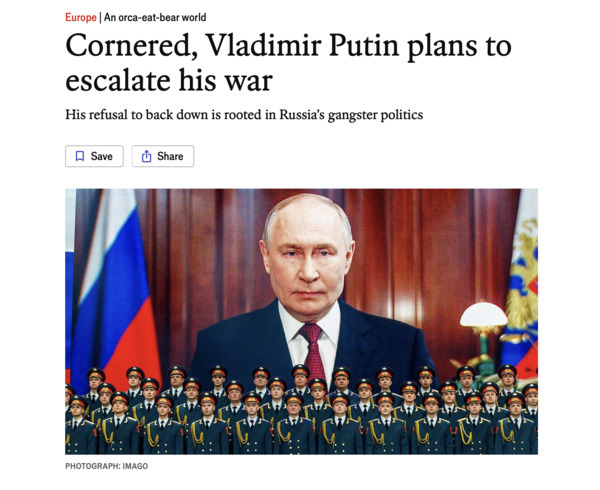
이코노미스트는 ‘Cornered, Vladimir Putin plans to escalate his war’(궁지에 몰린 블라디미르 푸틴, 전쟁 확대를 계획하다)라는 제목의 기사에서 “물러서기를 거부하는 푸틴의 태도는 러시아의 ‘갱스터 정치’에 뿌리를 두고 있다”고 분석했다.
이코노미스트에 따르면 우크라이나는 최근 러시아 정유시설과 물류센터에 대한 드론 공격을 강화하고 있다. 공격 대상에는 러시아 최대 전자상거래 업체 와일드베리스(Wildberries)의 물류창고도 포함됐다.
푸틴은 지난달 22일 연설에서 우크라이나가 “판도라의 상자”를 열었다며 “너희 경제의 가장 민감한 부문에 역풍이 닥칠 것”이라고 경고했다. 같은 날 통합러시아당을 상대로 한 연설에서도 “특별군사작전은 계속된다. 우리는 오직 앞으로만 나아갈 것”이라며 전쟁을 끝낼 뜻이 없음을 분명히 했다.
이코노미스트는 이어 “8월 30일 러시아 국방부가 우크라이나의 에너지 기반시설을 겨냥한 대규모 공격을 준비하고 있다고 밝혔다”고 전했다.
지상전에서도 확전 가능성이 제기됐다. 러시아 측 소식통들은 푸틴이 추가로 30만~40만 명의 병력을 전쟁이라는 ‘고기 분쇄기’에 투입할 방침이라고 전했다. 이코노미스트는 “새로운 동원령을 발표할 필요도 없다. 푸틴은 최초의 동원 명령을 중단한 적이 없기 때문”이라고 분석했다.
그러면서 “우크라이나는 이미 올겨울 자국의 저항 의지를 꺾으려는 러시아의 전면 공세 가운데 하나로 이러한 공격을 예상하고 있다”고 전했다.
이코노미스트는 푸틴이 이른바 ‘내부의 적’에 대한 탄압도 강화할 수 있다고 내다봤다.
그 이유에 대해서는 “그들이 실제로 자신의 권력에 위협이 되기 때문이 아니라, 자신이 강하다는 것을 보여줄 필요가 있기 때문”이라며 “하지만 이 가운데 어느 것도 러시아가 직면한 문제를 해결하지 못할 것이다. 오히려 국민의 고통을 더욱 키우고 러시아 국내뿐 아니라 국외의 불안정까지 심화시킬 가능성이 크다”고 분석했다.
이어 “최근 NATO 국가들은 푸틴의 생각이 어떤 방향으로 흘러가고 있는지 갈수록 우려하고 있다”며 “러시아군은 수년째 전선에서 사실상 교착상태에 빠져 있으며, 매달 수만 명이 전사하거나 중상을 입고 있다”고 전했다.
또 “전쟁은 드론과 미사일을 주고받는 파괴적인 소모전으로 변했다. 우크라이나가 막대한 피해를 입고 있지만 러시아 역시 눈에 띄는 피해를 보고 있다”며 “그런데도 푸틴은 물러설 기미를 보이지 않는다”고 했다.
이어 “우려되는 것은 푸틴이 과거에도 그랬듯 러시아인들이 ‘투피크(tupik·막다른 길)’라고 부르는 상황에서 벗어나기 위해 새로운 방식으로 전쟁을 확대하려 할 수 있다는 점”이라고 분석했다.
이코노미스트는 지난달 25일 존 랫클리프 미국 중앙정보국(CIA) 국장이 예고 없이 모스크바를 방문한 것도 서방의 불안감을 보여주는 징후로 해석했다.
기사는 “랫클리프가 푸틴에게 NATO 국가들을 공격하지 말라고 경고하기 위해 간 것인지, 아니면 러시아의 암울한 전망을 전달하며 협상에 나서도록 설득하기 위해 간 것인지를 두고는 설명이 엇갈린다”며 “그로부터 사흘 뒤 핀란드는 러시아의 국경 침범을 감시하기 위해 스웨덴 항공기와 군함의 지원을 요청했다”고 전했다.
독일은 8월 4일 라이프치히 공항에서 발생한 드론 공격의 배후로 러시아를 공개 지목할 준비를 하고 있으며 추가 제재에 나설 가능성도 있다. 루마니아는 8월 20일 자국 영해의 시추 플랫폼을 겨냥한 러시아 해상 드론을 파괴했다고 밝혔다. 8월 25일에는 슬로바키아가 드론 공장을 겨냥한 방화 공격을 저지했다.
이코노미스트는 이러한 움직임들이 푸틴이 전쟁을 새로운 방식으로 확대할 가능성에 대한 서방의 불안감이 커지고 있음을 보여준다고 분석했다.
아래는 해당 기사의 원문이다.
On august 29th, meeting with staff and students at a university in Moscow, Vladimir Putin observed that orcas feed on polar bears. "That's the food chain," Russia's president stated. "Children should be taught about this, so that they understand what kind of world we live in and why we are conducting the special military operation"-his term for Russia's war on Ukraine.
The claim was fanciful: there is no known case of an orca eating a polar bear. But it provided some insight into Mr Putin's predatory worldview. Recently nato countries have become increasingly concerned about the direction his thoughts might be taking. Russia's army has been largely stalemated for years, suffering tens of thousands of men killed or severely wounded each month. The war has become a ruinous contest of drone and missile attacks that, while devastating to Ukraine, are inflicting visible damage on Russia too. But Mr Putin shows no sign of backing off. The worry is that he may try to escape from what Russians call a tupik (dead-end) as he has in the past: by finding some new way to escalate the conflict.
The signs of Western anxiety are all around. On August 25th John Ratcliffe, the director of America's cia,
unexpe
ctedly flew to Moscow. Accounts differ on whether he went to warn Mr Putin not to attack nato countries, or to deliver a bleak assessment of Russia's prospects and persuade him to negotiate. Three days later Finland requested the help of Swedish aircraft and warships in monitoring its border with Russia for incursions. Germany is preparing to openly blame Russia for a drone attack at Leipzig's airport on August 4th, and will probably impose further sanctions. On August 20th Romania says it destroyed a Russian naval drone that targeted a drilling platform in its waters. On August 25th Slovakia foiled an arson attack on a drone factory.
Meanwhile Mr Putin has ended his long silence over Ukraine's increasingly successful drone attacks on
Russian oil refineries and logistics centres, including warehouses belonging to Wildberries, Russia's largest e-retailer. In an address on August 22nd he accused Ukraine of opening a "Pandora's box" and promised "blowback on the most sensitive sectors of your economy". Earlier that day, speaking to United Russia, the Kremlin's political party, he dismissed any notion of ending the war. "The special military operation continues," he vowed. "We will move only forward."
Sources close to the Kremlin say that, after several weeks of consideration over the summer,he seems to have chosen to escalate. Indeed, a longtime associate of Mr Putin says he is likely to have seen Mr Ratcliffe's visit as a sign of American weakness. That, the source said, was the president's interpretation of the visit to Moscow in November 2021 by Bill Burns, Joe Biden's cia director, to warn him against invading Ukraine. He went ahead three months later.
No one can know what is inside Mr Putin's head. But his reasons for escalating the war, like the decision to invade in the first place, are internal. His key objective has always been preserving his own power, and ultimately his life.One concern for the Kremlin is the evaporation of the p
olence, but is unforgiving of failure. He probably believes that ending the war without achieving even his minimum goal, taking all of Ukraine's eastern Donbas region, would put him physically at risk. ("They will hang me," he told some of his cronies at one point during the war, according to an in
ublic's silent assent for the war. Deep strikes by Ukrainian drones on refineries and e-retailers, along with internet restrictions imposed by security services, have shattered the veneer of normal life. The Levada Centre, an independent pollster, says 57% of Russians describe the situation as "tense"; respondents cite the war, the death toll, mobilisation, drone attacks and the lack of a sense of the future. Public trust in television propaganda is falling, and young people post calls to end the war on social media. Mr Putin's approval rating is sliding.
The mood among elites is even more sour. The biggest issue, one insider says, is not so much the economy or the lack of military success, but the time the war has wasted: whatever the outcome, nearly five years is a failure. There is a growing쟣eeling that the tsar is naked, says another member of the elite. None of Russia's economic or political problems is fatal to Mr Putin: he has the economic resources and the repressive apparatus to carry on. But perception matters.
Mr Putin may express his aims using the language of geopolitics, but in fact he is guided by the criminal logic of his regime: never show weakness. Russia's system has a high tolerance for violence, but is unforgiving of failure. He probably believes that ending the war without achieving even his minimum goal, taking all of Ukraine's eastern Donbas region, would put him physically at risk. ("They will hang me," he told some of his cronies at one point during the war, according to an insider.)
Carrying on the war in its current form, meanwhile, is no solution. "Inertia-driven scenarios are disadvantageous to the Kremlin," one member of the Russian elite says: they simply consume economic resources and waste political capital.
All this might make escalation seem attractive. But it is not clear what it would entail. Russia is likely to intensify hybrid warfare and sabotage against Ukraine's allies and target supply routes from Europe to Ukraine. Western intelligence agencies worry that Russia might target factories in Europe that make materiel for Ukraine's war effort. But they think Mr Putin does not want a direct military confrontation with nato.
Within Ukraine, escalation largely means scaling up things Russia is already doing. On August 30th Russia's ministry of defence said it was preparing a massive strike on Ukraine's energy infrastructure. But Ukraine already expects such attacks as part of Russia's all-out offensive to break its will this winter. As for the ground war, Russian sources say Mr Putin is committed to throwing an additional 300,000-400,000 men into the meat grinder. He does not need to announce a new wave of mobilisation: he never suspended his initial mobilisation order. Extra men will probably be recruited using coercion by regional governments to keep any political discontent localised. The authorities are already testing the new recruitment system in Penza, a region 750km south-east of Moscow.
Mr Putin might also intensify repression of supposed "internal enemies", not because they pose any threat to his power but because he needs to demonstrate strength. None of this will solve any of Russia's problems. It is only likely to increase popular suffering and contribute to instability, both inside and outside the country.
#푸틴 #우크라이나전쟁 #러시아확전