
638 읽음
From the “Leather Gloves” of Cheonggyesan to the “Fireworks Festival” of Yeouido... A Look Inside Chairman Kim Seung-youn?
 최보식의언론
 1
1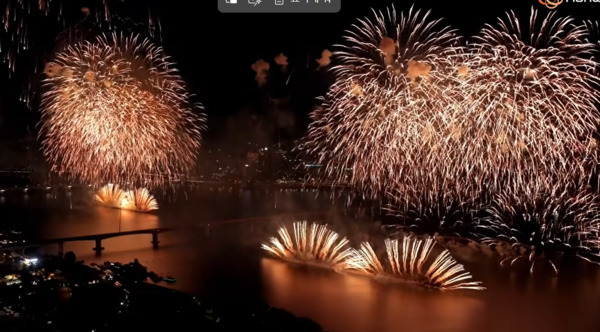
Hanwha invested 13 billion won in this spectacular festival. This year marked the 22nd edition of the event.
Ahead of this year’s festival, Hanwha Chairman Kim Seung-youn said, “The reason Hanwha sends fireworks into the sky is because the happiness they bring can be shared by everyone looking up at the sky, and we want to share that happiness.”
Those who watched the fireworks in person may indeed have felt that happiness—and perhaps even felt that “corporations are greater than governments.”
This year, Korea’s Hanwha Corporation and teams representing the United States and the United Kingdom participated. The Korean team staged its performance under the theme “The Starry Night – Puzzle of Light,” inspired by Vincent van Gogh’s masterpiece The Starry Night.
Centered around Wonhyo Bridge, a “decalcomania” display unfolded with fireworks symmetrically illuminating both sides of the sky above the Han River. Fireworks forming words such as “SEOUL” and “WE ARE HANWHA” were also presented.
Below is a post that Chosun Ilbo reporter Noh Seok-jo uploaded to his personal social media account after watching the international fireworks festival on the Han River in person. His keen journalistic eye stands out. (Editor’s Note)
On September 5, 2026, I watched Hanwha’s Seoul International Fireworks Festival.
As I watched the fireworks fill Seoul’s night sky and listened to the cheers of the enormous crowd, I suddenly found myself thinking about the Hanwha Group.
For me, the first memory associated with the names “Hanwha” and “Kim Seung-youn” is not fireworks, but “leather gloves.”
In 2007, Chairman Kim Seung-youn mobilized company security personnel and others in what became known as the “Cheonggyesan revenge assault case,” after his second son was injured at a bar. He was sentenced in the first trial to 18 months in prison. On appeal, he received an 18-month prison sentence suspended for three years, along with 200 hours of community service.
For a long time, therefore, Kim Seung-youn represented to me something close to the archetype of a rough and dangerous corporate owner.
That memory has not disappeared. The passage of time and the company’s subsequent success cannot glorify or excuse what happened.
But when one looks at the path Hanwha has taken since then, another question arises.
How did this group grow so much?
After returning home and looking through newspaper and broadcast reports, I found that Hanwha is widely regarded as a company that has grown through mergers and acquisitions.
In 2002, it acquired Korea Life Insurance, which had accumulated losses exceeding 2 trillion won, and eliminated its insolvency within six years. In 2012, Hanwha acquired the bankrupt German company Q-Cells, laying the foundation for its solar-energy business.
One of the decisive moments was the “big deal” with Samsung, announced in 2014 and completed in 2015.
Hanwha spent approximately 1.9 trillion won to acquire four Samsung defense and chemical affiliates: Samsung Techwin, Samsung Thales, Samsung General Chemicals and Samsung Total. It spent 823.2 billion won just to acquire a 32.4 percent stake in Samsung Techwin.
At the time, Samsung Techwin was producing K9 self-propelled howitzers and aircraft engines, while Samsung Thales possessed technologies in radar, command and control, and defense electronics. Hanwha, which had been strong in ammunition and explosives, used the deal to expand at once into self-propelled artillery, aircraft engines, radar and defense electronics.
But buying a company and making proper use of that company are two different things.
The following year, Hanwha acquired Doosan DST as well, and continued consolidating and reorganizing its scattered defense affiliates. Samsung Techwin became Hanwha Techwin and later Hanwha Aerospace. In 2022, Hanwha Defense and Hanwha Corporation’s defense division were also brought under Hanwha Aerospace.
The fact that Hanwha Aerospace today handles K9 self-propelled howitzers, Chunmoo multiple rocket launchers, armored vehicles, aircraft engines and space launch vehicles is not simply the result of buying one good company from Samsung. It is closer to the result of spending nearly a decade assembling technologies and personnel scattered across multiple companies into a single industrial system.
In 2025, Hanwha Aerospace posted consolidated revenue of 26.6 trillion won and operating profit exceeding 3 trillion won. There was certainly a favorable global surge in defense demand following the Russia-Ukraine war, but it is also true that Hanwha had prepared the ship and sails to catch that wind long beforehand.
Hanwha Ocean tells a similar story.
Hanwha attempted to acquire Daewoo Shipbuilding & Marine Engineering in 2008 but failed. Fifteen years later, it tried again and brought the company into the group in 2023 as Hanwha Ocean. In 2025, Hanwha Ocean recorded revenue of 12.6 trillion won and operating profit of 1.1 trillion won.
Here, another distinctive characteristic of Hanwha emerges.
After acquiring the shipyard, Hanwha did not simply try to build more ships in Korea. In 2024, it also acquired Philly Shipyard in Philadelphia, United States. It subsequently announced plans to invest $5 billion there to expand America’s capacity to build commercial vessels and naval ships.
Hanwha’s U.S. strategy is also worth examining.
Chairman Kim Seung-youn has maintained a relationship for more than 40 years with Edwin Feulner, former president of the Heritage Foundation, a leading conservative U.S. think tank. Feulner also served as an outside director of Hanwha Corporation.
Kim’s eldest son, Vice Chairman Kim Dong-kwan, attended President Trump’s inauguration and other major events, making contact with Republican figures.
But Hanwha has not aligned itself solely with Republicans.
During the Biden administration, Hanwha Qcells invested $2.5 billion in Georgia to build a U.S. solar-energy supply chain. President Biden personally described it as a “big deal,” while Democratic Georgia Senator Jon Ossoff also met Vice Chairman Kim Dong-kwan and praised Hanwha’s investment. Republican Georgia Governor Brian Kemp likewise welcomed the investment and the jobs it created.
Hanwha’s lobbying expenditures in the United States have also increased significantly. Yet Hanwha’s influence in Washington is difficult to explain solely through lobbyists or personal connections.
When the Biden administration emphasized climate change and clean-energy supply chains, Hanwha built solar factories in Georgia. When the Trump administration sought to counter China and revive America’s shipbuilding industry and naval power, Hanwha offered its Philadelphia shipyard and defense investments.
Governments have ideologies, but companies have businesses.
Rather than simply managing political contacts on both sides of the Democratic-Republican divide, Hanwha built factories, technologies and jobs that the United States would need regardless of which administration was in power.
Personal connections may have opened the relationship, but what sustained it over the long term was ultimately investment and mutual interests.
The direction of succession was also divided relatively early.
Eldest son and Vice Chairman Kim Dong-kwan oversees defense, shipbuilding, aerospace and energy. Second son and Vice Chairman Kim Dong-won is responsible for finance, centered on Hanwha Life, as well as digital and global businesses. Third son and President Kim Dong-sun leads retail, hotels, leisure and food services, along with technology and lifestyle businesses such as robotics and semiconductor equipment.
Rather than assigning all three sons the same businesses and forcing them to compete against one another, the group divided their respective areas and made each responsible for performance.
With all three sons promoted in 2026, the contours of third-generation management centered on Vice Chairman Kim Dong-kwan have become even clearer.
Of course, it is still too early to say that the succession process has been fully completed, considering unresolved issues involving shareholding arrangements, the possible separation of affiliates and shareholder value. It also remains to be seen what long-term results the three sons will produce in their respective businesses.
Still, one distinctive feature of Hanwha’s succession appears to be that it did not leave the succession structure ambiguous and allow the brothers to clash over the same position. Instead, their roles were divided relatively early.
How was Hanwha able to do all of this?
It may have been the combined result of contrarian thinking that led it to acquire companies others avoided during moments of crisis; the patience to invest in acquired companies over long periods rather than treating them as targets for short-term profit; the organizational execution needed to combine technologies and people from different companies into one system; an external strategic sense that built relationships of mutual interest capable of surviving changes in government; and a succession plan that divided responsibilities among the next generation early on.
At the center of all this was Chairman Kim Seung-youn’s powerful ownership leadership.
But concentrated authority and bold decision-making are not virtues in themselves.
When directed toward personal anger, they can become the violence of Cheonggyesan. When directed toward industrial judgment and a long-term timetable, they can become investments lasting decades.
Perhaps strong ownership leadership is neither inherently good nor evil. It is more like an amplifier.
The outcome can be radically different depending on the direction in which that power is used and the institutions and organizations that keep it under control.
The fireworks festival I watched today is interesting in this respect as well.
Hanwha has continued the event as a social-contribution project since 2000. Most viewing areas are open to citizens free of charge, and after the event Hanwha employees participate in a cleanup campaign to collect trash.
At the same time, the festival is also an enormous branding project that connects the two syllables of “Hanwha” with one of Seoul’s most beautiful nights.
Social contribution and marketing are not necessarily contradictory.
If a company can transform its technology, money and organizational capabilities into enjoyment for citizens while also gaining brand value, that is a fairly clever and productive exchange.
A person cannot be fully explained by a single incident.
But later success does not erase past wrongdoing either.
The leather gloves of Cheonggyesan and the fireworks of Yeouido.
For a moment, I found myself thinking that perhaps good management is not about possessing great power, but about choosing correctly where that power should be directed—and then spending years building the people, technology and relationships necessary to turn that choice into reality.
#Hanwha #KimSeungYoun #CorporateLeadership
* This article has been translated by ChatGPT.