
100 읽음
Is Starbucks Turning Minority Report Into Reality?
 최보식의언론
 0
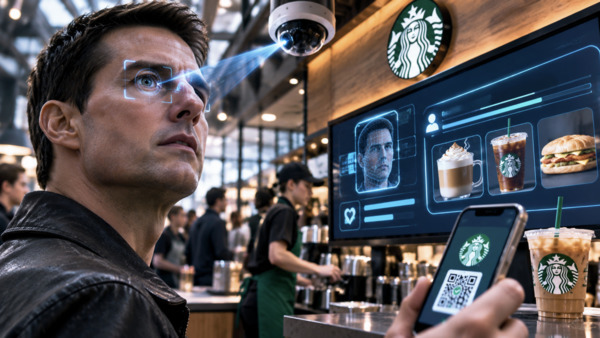
There is a well-known scene in Steven Spielberg’s 2002 film Minority Report.
John Anderton, played by Tom Cruise, enters a clothing store after having another person's eyes transplanted to avoid iris recognition. The store's system immediately scans his eyes and greets him by the name of the Japanese customer who originally owned them. It then asks whether he liked the tank top he purchased last time.
Audiences laughed, but behind that laughter lay anxiety about a society in which every consumer is tracked and classified.
Now, 24 years later, Starbucks is trying to bring that very scene into reality with the help of AI.
During its recent earnings presentation, Starbucks announced that it would focus on a “major technology modernization” centered on the adoption of artificial intelligence through 2027. These days, few companies do not talk about investing in AI, so there is nothing particularly new about that in itself.
What attracted attention was a remark by CEO Brian Niccol.
He said the company was exploring ways to recognize loyal customers the moment they arrive at a store, display digital menus tailored to them, and make payments more convenient.
Separately, the company also announced plans to begin testing an AI model to help baristas enter orders at drive-through locations starting in fiscal 2027.
The question is what it means to “recognize” someone.
Starbucks may not scan customers' irises as in the movie, but concerns will be difficult to dispel unless the company discloses what technology it will use to identify customers and what data it will rely on to construct personalized menus.
We are already being tracked through countless channels, and the data accumulated in this way is traded among companies.
The dystopia depicted in the film is no longer science fiction.
The most obvious method we can imagine would be facial recognition.
The central criticism goes beyond the invasion of privacy and extends to pricing.
Lindsay Owens, executive director of the consumer advocacy organization Groundwork Collaborative, is also the author of Gouged.
She argues that what is actually being prepared under the guise of personalized menus is an AI pricing system precisely calibrated to the maximum amount each individual customer is willing to pay.
This is a warning that what economists call first-degree price discrimination could become a reality through data and algorithms.
Under such a system, each consumer is charged according to their willingness to pay, allowing the company to capture the entire consumer surplus.
When Arthur Pigou formulated the concept a century ago, it was an extreme case confined to economic theory.
But now that behavioral data can be analyzed in real time, it has become a technically feasible strategy.
Many companies have succeeded with this approach.
Dell Computers, for example, allowed consumers to configure their own PC specifications rather than choose from fixed models. Through this personalized service, which made price comparisons with competing products difficult, Dell was able to generate substantial profits.
Some critics point out that Starbucks unveiled this idea during the very week the U.S. Federal Trade Commission (FTC) ordered companies engaged in so-called “surveillance pricing” to submit information.
In other words, just as regulators were beginning to take action, Starbucks chose a path that could make it a target of investigation.
Some privacy-conscious observers believe consumers will not accept such practices.
However, as Dell's success demonstrates, people willingly accept personalization when it provides differentiated value that benefits them.
For Starbucks to make this experiment successful, it simply needs to make clear what new value it is offering customers.
If I have no way of knowing whether the pumpkin spice latte I purchased at a drive-through costs the same as the one purchased by the customer in the car behind me, I may feel both the discomfort of being watched and the suspicion that I am being overcharged.
Personalized pricing and services succeed when price comparisons are impossible.
Unlike custom-built PCs, whether Starbucks can offer genuinely differentiated products and value through personalized services is a challenge the company must address.
Critics put it this way.
Personalization promises convenience, but in exchange, it increases information asymmetry.
Companies come to know their customers with ever greater precision, while customers have no idea how the prices they are charged are determined.
For markets to function efficiently, prices must be transparent and comparable.
But if different prices for different individuals become commonplace, that fundamental assumption begins to crumble.
Where should the line be drawn between innovation in customer experience and the erosion of trust?
But companies are not stupid.
It is naive to assume that corporate executives would offer personalized services without understanding consumers' concerns and discomfort over privacy and information asymmetry.
That is the naivety of people who have never made money in business.
When companies win customers over to their side, they invariably provide value to those customers.
No foolish executive believes that a service in which benefits are asymmetrically monopolized by the company alone can succeed.
btlee@kaist.ac.kr
#Starbucks #AIPrivacy #SurveillancePricing
* This article has been translated by ChatGPT.